

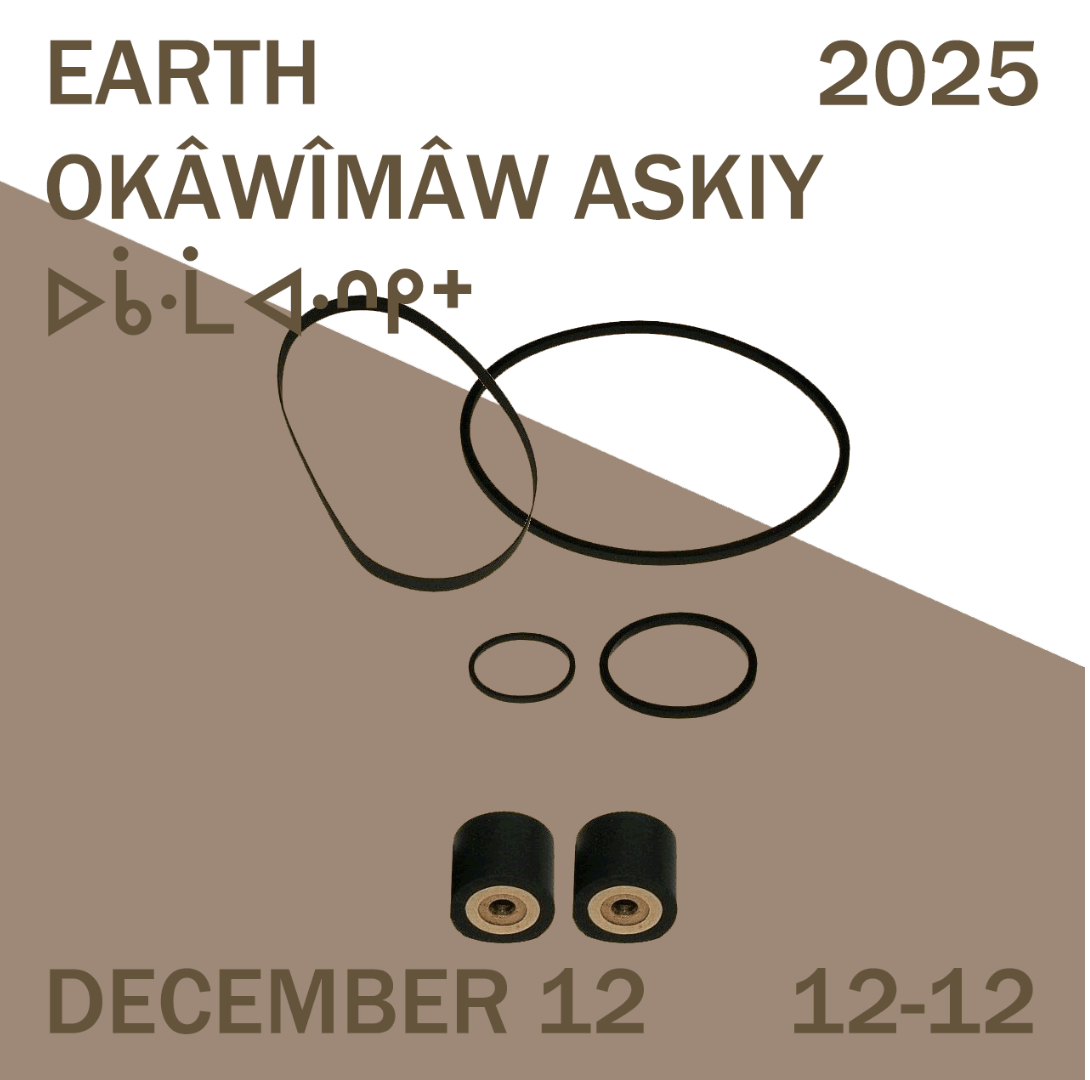
Lien : https://youandiarewaterearthfireairoflifeanddeath.com/project/earth-2025
Regina (UTC-6) le 12 décembre : de 12:00 à 24:00…….. Montréal (UTC-5) : 13:00 à 01:00 (le13)
PROGRAMME
PRESENTED BY: University of Saskatchewan Art Galleries and CollectionDECEMBER 12, 2025
12 NOON – 12 MIDNIGHT (EST)LIVE IN-PERSON AT:
ROUNDING space at the Kenderdine Gallery, USask Galleries, University of Saskatchewan, Saskatoon, Saskatchewan (free) (venue is accessible)LIVESTREAMED ONLINE ON:
YouTube LivestreamAND VIA STREAMING PARTNERS:
NAISA, Radius, Radio Bloc Oral, Resonance Extra, and Wave Farm Radio
12 NOON – 12 MIDNIGHT (EST)LIVE IN-PERSON AT:
ROUNDING space at the Kenderdine Gallery, USask Galleries, University of Saskatchewan, Saskatoon, Saskatchewan (free) (venue is accessible)LIVESTREAMED ONLINE ON:
YouTube LivestreamAND VIA STREAMING PARTNERS:
NAISA, Radius, Radio Bloc Oral, Resonance Extra, and Wave Farm Radio


EARTH (OKÂWÎMÂW ASKIY – ᐅᑳᐧᒫᐊᐧᐢᑭᕀ) – HOUR 1
12 CST, 13 EST, 18 GMT, 19 CETUniversity of Saskatchewan Art Galleries and Collection PRESENTS Aurora Wolfe, and Joseph NaytowhowJoseph Naytowhow, kēhtē-aya (elder), musician, story teller and artist, Plains Cree/Woodland Cree, Sturgeon Lake First Nation, Treaty 6 Territory, is the advisor to the Indigenous Law Centre, College of Law, Usask and a steering committee member for kihci-okāwīmāw askiy (Great Mother Earth) Knowledge Centre (Great Mother Earth) Knowledge Centre. kihci-okāwīmāw askiy is founded on the principle that the land is our first teacher and of central importance to Indigenous peoples. The centre serves as a resource for Indigenous communities and organizations seeking information, training, and research partnerships. He will welcome us and begin this event in a good way.bounty by Aurora WolfeFragments can take many forms. Sounds, images, and memories are brought together in this composition, grounded in the grasslands of my childhood. Wrapped in the bones of my kin, 15 years after my departure – I returned. I laid down tobacco and searched for answers. I expected to see the hurt that I had been holding within myself reflected in the landscape. Instead, I found transformation and the quiet strength in those reconfigurations.
12 CST, 13 EST, 18 GMT, 19 CETUniversity of Saskatchewan Art Galleries and Collection PRESENTS Aurora Wolfe, and Joseph NaytowhowJoseph Naytowhow, kēhtē-aya (elder), musician, story teller and artist, Plains Cree/Woodland Cree, Sturgeon Lake First Nation, Treaty 6 Territory, is the advisor to the Indigenous Law Centre, College of Law, Usask and a steering committee member for kihci-okāwīmāw askiy (Great Mother Earth) Knowledge Centre (Great Mother Earth) Knowledge Centre. kihci-okāwīmāw askiy is founded on the principle that the land is our first teacher and of central importance to Indigenous peoples. The centre serves as a resource for Indigenous communities and organizations seeking information, training, and research partnerships. He will welcome us and begin this event in a good way.bounty by Aurora WolfeFragments can take many forms. Sounds, images, and memories are brought together in this composition, grounded in the grasslands of my childhood. Wrapped in the bones of my kin, 15 years after my departure – I returned. I laid down tobacco and searched for answers. I expected to see the hurt that I had been holding within myself reflected in the landscape. Instead, I found transformation and the quiet strength in those reconfigurations.
Time (Less) – 1The last twenty-five minutes of the 1st hour feature the contribution of Laura St. Pierre to the Time (Less) series.All Flourishing 1 by Laura St. Pierre. Laura St. Pierre’s speculative practice has engaged The Sower as a primary character for a while now. In her 2022 exhibition, SÈME LA PEAU / SEED THE SKIN, the Sower had begun to integrate her body into the care required for the proliferation of foodstuffs and plant matter, there was a unique tenderness to this vulnerability that was also heavily surveilled. This new work reveals a next level of intimacy and interdependence as The Sower has both found and produced sites for growth between the bodies of others now present in her interpreted world. All Flourishing becomes the line that carries through because it reflects the relational nature of liveness, but also the spatial proximity required to engage in well-being, and how it must be fostered. This extends to thoughts about borders perceived and actual, and the care our species must take up urgently is we are planning to survive. There is a slowness to the work that becomes the time keeper, the chorus, the return.
EARTH (OKÂWÎMÂW ASKIY – ᐅᑳᐧᒫᐊᐧᐢᑭᕀ) – HOUR 2
13 CST, 14 EST, 19 GMT, 20 CETUniversity of Saskatchewan Art Galleries and Collection PRESENTS Parsons & Charlesworth, Dawit L. Petros, Michaela Grill & Karl Lemieux. Algae Kin Gatherer by Parsons and CharlesworthA floating sanctuary for multispecies communion, the Algae Kin-Gatherer is a public sculpture and is the first physical manifestation from the climate fiction Multispecies Inc. This woven willow raft, mounted on ash and sealed with dyed ballistic nylon, enables humans to forge intimate relationships with microscopic aquatic life.In a time of ecological upheaval, the Algae Kin-Gatherer serves as both functional tool and provocative symbol—challenging us to envision futures where humans develop meaningful connections with non-human life forms, particularly those invisible to the naked eye yet crucial to our planetary systems.The Sea In Its Thirst Is Trembling by Dawit L. PetrosDawit L. Petros’ The Sea In Its Thirst Is Trembling (2019) documents a collaborative sound intervention conceived for Ríos Intermitentes (Intermittent Rivers) during the 13th Havana Biennial in Matanzas, Cuba. The live performance took place along the San Juan River, under a bridge, which ultimately connected musical traditions, histories, and cultures.The Great Thaw (intro) by Michaela Grill and Karl Lemieux
What does it mean to represent the visual traces of environmental destruction? How to communicate the temporality of global heating in a time-based medium? The Great Thaw is ultimately an experiment in documentary filmmaking and a foray into scientific communication. Collaborating with scientific researchers, the filmmakers shift between relaying facts and creating an experience of those facts, allowing the spectator to feel the environmental changes and sense the physical transformations. The interplay of analogue and digital imagery (the media of choice of Lemieux and Grill respectively), combined with the intricately composed soundtrack and the oscillation between abstraction and figuration, opens a space for embodied understandings and the fluid movement of thought.
13 CST, 14 EST, 19 GMT, 20 CETUniversity of Saskatchewan Art Galleries and Collection PRESENTS Parsons & Charlesworth, Dawit L. Petros, Michaela Grill & Karl Lemieux. Algae Kin Gatherer by Parsons and CharlesworthA floating sanctuary for multispecies communion, the Algae Kin-Gatherer is a public sculpture and is the first physical manifestation from the climate fiction Multispecies Inc. This woven willow raft, mounted on ash and sealed with dyed ballistic nylon, enables humans to forge intimate relationships with microscopic aquatic life.In a time of ecological upheaval, the Algae Kin-Gatherer serves as both functional tool and provocative symbol—challenging us to envision futures where humans develop meaningful connections with non-human life forms, particularly those invisible to the naked eye yet crucial to our planetary systems.The Sea In Its Thirst Is Trembling by Dawit L. PetrosDawit L. Petros’ The Sea In Its Thirst Is Trembling (2019) documents a collaborative sound intervention conceived for Ríos Intermitentes (Intermittent Rivers) during the 13th Havana Biennial in Matanzas, Cuba. The live performance took place along the San Juan River, under a bridge, which ultimately connected musical traditions, histories, and cultures.The Great Thaw (intro) by Michaela Grill and Karl Lemieux
What does it mean to represent the visual traces of environmental destruction? How to communicate the temporality of global heating in a time-based medium? The Great Thaw is ultimately an experiment in documentary filmmaking and a foray into scientific communication. Collaborating with scientific researchers, the filmmakers shift between relaying facts and creating an experience of those facts, allowing the spectator to feel the environmental changes and sense the physical transformations. The interplay of analogue and digital imagery (the media of choice of Lemieux and Grill respectively), combined with the intricately composed soundtrack and the oscillation between abstraction and figuration, opens a space for embodied understandings and the fluid movement of thought.
Time (Less) – 2The last twenty-five minutes of the 2nd hour feature the contribution of Laura St. Pierre to the Time (Less) series.More info under Hour 1 above or here.

EARTH (OKÂWÎMÂW ASKIY – ᐅᑳᐧᒫᐊᐧᐢᑭᕀ) – HOUR 3
14 CST, 15 EST, 20 GMT, 21 CETUniversity of Saskatchewan Art Galleries and Collection PRESENTS Michaela Grill & Karl LemieuxThe Great Thaw (2024) by Michaela Grill & Karl Lemieux What does it mean to represent the visual traces of environmental destruction? How to communicate the temporality of global heating in a time-based medium? These are the questions tackled by Michaela Grill and Karl Lemieux’s experimental documentary exploring permafrost thaw and its effects on diverse ecosystems. The film does not shy away from the gravity of the situation, the title alluding not only to potential futures but equally to a very tangible and disastrous present. Gliding camera movements reminiscent of Grill’s Into the Great White Open reveal the surfaces and contours of Arctic snow-covered landscapes that drift in and out of abstraction, confusing scale and perspective. As we settle into the beauty of the images, it becomes clear that what we are seeing is the great thaw itself, evidenced in the exposed rock faces, the melting ice and the sounds of water that gradually seep through the layers of electronic music. If these opening drone images draw us into a sense of the sublime, the scientific facts presented in a series of intertitles bring us solemnly back down to earth, informing us of the consequences of inaction.The Great Thaw is ultimately an experiment in documentary filmmaking and a foray into scientific communication. Collaborating with scientific researchers, the filmmakers shift between relaying facts and creating an experience of those facts, allowing the spectator to feel the environmental changes and sense the physical transformations. The interplay of analogue and digital imagery (the media of choice of Lemieux and Grill respectively), combined with the intricately composed soundtrack and the oscillation between abstraction and figuration, opens a space for embodied understandings and the fluid movement of thought. Avoiding the didactic, the film nonetheless wills us to confront reality. As the final intertitle states, quoting from Thomas Halliday’s book Otherlands: A World in the Making, ‘We know that change is occurring, we know that we are responsible, we know what will happen if it continues, we know that we can stop it, and we know how. The question is whether we will try.’ (Kim Knowles)The Great Thaw is a project about permafrost thaw and how landscape is changed by it. We take a close look at ecosystems like the boreal forest, the tundra and the arctic coastline to document the impacts of the melting permafrost caused by climate change and to present the beauty of permafrost itself. After Antarctic Traces, The Great Thaw is a new part of the Ecological Grief Series which focuses on different aspects of human interaction with nature in the Anthropocene. The series investigates environmental melancholia and the loss of places, species and ecosystems.credits: sound recording, sound design and original music: Nick Kuepfer / production: Michaela Grill / scientific advisor: Jennifer Watts, Woodwell Climate Research Centre / additional research and production assistant: Peter Burton / additional camera: Caleb Molinar / image restoration consultant: Patrick Bergeron / additional scientific advisor: Dr. Christopher Burn, Chancellor’s Professor of Geography Carleton University, President International Permafrost Associationwith (in order of appearance): Dr. Alexander L. Kholodov, Permafrost Laboratory, Geophysical Institute, University of Alaska Fairbanks / Valeria Briones, Research Assistant, Woodwell Climate Research Centre / Dr. Jennifer Watts, Ecologist, Woodwell Climate Research Centre / Christina Minions, Research Assistant, Woodwell Climate Research Centre / Anne Yutrzenka, Alaska resident and science teacher / Martin Edwardsen, Arctic Indigenous Traditional Ecological Knowledge Specialist at Ukpeaġvik Iñupiat Corporation Science / Jeremiah Goodwin / Van Edwardsen / Terza Browerscientific input: Dr. Gaku Amada, Institute of Arctic Climate and Environment Research, Research Institut for Global Change, Japan Agency for Marine-Earth Science and Technology / Tom Douglas, U.S. Army Corps of Engineers, Permafrost Tunnel / Celtie Ferguson, GIS Technician, Western Arctic Research Centre, Aurora Research Institute / Dr. Helene Genet, Institute of Arctic Biology at University of Alaska Fairbanks / Prof. Stephan Gruber, Geography and Environmental Studies, Carleton University / Nick Hasson, Water and Environmental Research Center at University of Alaska Fairbanks / Adrienne Hill, implementation and governance manager First Nation of Na-Cho Nyäk Dun / Jennifer Humphries, Permafrost Specialist, Western Arctic Research Centre, Aurora Research Institute / Dr. Hideki Kobayashi, Institute of Arctic Climate and Environment Research, Research Institute for Global Change, Japan Agency for Marine-Earth Science and Technology / jake moore, Faculty Member in Art & Art History, Head of University Art Galleries and Art Collection at University of Saskatchewan / Darcy L. Peter, Alaska Conservation Foundation / Dr. Ted Schuur, Ecosystem Science and Society, Department of Biological Sciences at Northern Arizona Universityproduction input: Chad Diesiger, Assistant Station Manager, Toolik Field Station, Institute of Arctic Biology / Randy Fulweber, GIS & Remote Sensing Manager, Toolik Field Station, Institute of Arctic Biology / Peter C. Griffith, Lead Scientist Arctic Boreal Vulnerability Experiment (ABoVE), NASA Carbon Monitoring System / Torre Jorgenson, Alaska Ecoscience / Krystyna Kozioł, Department of Analytical Chemistry, Gdansk University of Technology / Nikki Lindt / Mia Vlacich, Helo Coordinator, Toolik Field Station, Institute of Arctic Biology / Amanda Young, Spatial & Environmental Data Center Manager, Toolik Field Station, Institute of Arctic Biologythanks: Steve Bates / Alexis Cadorette-Vigneau / Gina Deyoung / Mariana Frandsen / Thomas Halliday / Lukas Marxt / Barbara Pichler / Deanna Radfordin memory of Philip Jecksupported by: Canada Council for the Arts Research grant / Bm:koes Bildende Kunst, Architektur, Design, Mode, Foto und Medienkunst / Woodwell Climate Research Centre / Stadt Wien Kultur Arbeitsstipendium.
14 CST, 15 EST, 20 GMT, 21 CETUniversity of Saskatchewan Art Galleries and Collection PRESENTS Michaela Grill & Karl LemieuxThe Great Thaw (2024) by Michaela Grill & Karl Lemieux What does it mean to represent the visual traces of environmental destruction? How to communicate the temporality of global heating in a time-based medium? These are the questions tackled by Michaela Grill and Karl Lemieux’s experimental documentary exploring permafrost thaw and its effects on diverse ecosystems. The film does not shy away from the gravity of the situation, the title alluding not only to potential futures but equally to a very tangible and disastrous present. Gliding camera movements reminiscent of Grill’s Into the Great White Open reveal the surfaces and contours of Arctic snow-covered landscapes that drift in and out of abstraction, confusing scale and perspective. As we settle into the beauty of the images, it becomes clear that what we are seeing is the great thaw itself, evidenced in the exposed rock faces, the melting ice and the sounds of water that gradually seep through the layers of electronic music. If these opening drone images draw us into a sense of the sublime, the scientific facts presented in a series of intertitles bring us solemnly back down to earth, informing us of the consequences of inaction.The Great Thaw is ultimately an experiment in documentary filmmaking and a foray into scientific communication. Collaborating with scientific researchers, the filmmakers shift between relaying facts and creating an experience of those facts, allowing the spectator to feel the environmental changes and sense the physical transformations. The interplay of analogue and digital imagery (the media of choice of Lemieux and Grill respectively), combined with the intricately composed soundtrack and the oscillation between abstraction and figuration, opens a space for embodied understandings and the fluid movement of thought. Avoiding the didactic, the film nonetheless wills us to confront reality. As the final intertitle states, quoting from Thomas Halliday’s book Otherlands: A World in the Making, ‘We know that change is occurring, we know that we are responsible, we know what will happen if it continues, we know that we can stop it, and we know how. The question is whether we will try.’ (Kim Knowles)The Great Thaw is a project about permafrost thaw and how landscape is changed by it. We take a close look at ecosystems like the boreal forest, the tundra and the arctic coastline to document the impacts of the melting permafrost caused by climate change and to present the beauty of permafrost itself. After Antarctic Traces, The Great Thaw is a new part of the Ecological Grief Series which focuses on different aspects of human interaction with nature in the Anthropocene. The series investigates environmental melancholia and the loss of places, species and ecosystems.credits: sound recording, sound design and original music: Nick Kuepfer / production: Michaela Grill / scientific advisor: Jennifer Watts, Woodwell Climate Research Centre / additional research and production assistant: Peter Burton / additional camera: Caleb Molinar / image restoration consultant: Patrick Bergeron / additional scientific advisor: Dr. Christopher Burn, Chancellor’s Professor of Geography Carleton University, President International Permafrost Associationwith (in order of appearance): Dr. Alexander L. Kholodov, Permafrost Laboratory, Geophysical Institute, University of Alaska Fairbanks / Valeria Briones, Research Assistant, Woodwell Climate Research Centre / Dr. Jennifer Watts, Ecologist, Woodwell Climate Research Centre / Christina Minions, Research Assistant, Woodwell Climate Research Centre / Anne Yutrzenka, Alaska resident and science teacher / Martin Edwardsen, Arctic Indigenous Traditional Ecological Knowledge Specialist at Ukpeaġvik Iñupiat Corporation Science / Jeremiah Goodwin / Van Edwardsen / Terza Browerscientific input: Dr. Gaku Amada, Institute of Arctic Climate and Environment Research, Research Institut for Global Change, Japan Agency for Marine-Earth Science and Technology / Tom Douglas, U.S. Army Corps of Engineers, Permafrost Tunnel / Celtie Ferguson, GIS Technician, Western Arctic Research Centre, Aurora Research Institute / Dr. Helene Genet, Institute of Arctic Biology at University of Alaska Fairbanks / Prof. Stephan Gruber, Geography and Environmental Studies, Carleton University / Nick Hasson, Water and Environmental Research Center at University of Alaska Fairbanks / Adrienne Hill, implementation and governance manager First Nation of Na-Cho Nyäk Dun / Jennifer Humphries, Permafrost Specialist, Western Arctic Research Centre, Aurora Research Institute / Dr. Hideki Kobayashi, Institute of Arctic Climate and Environment Research, Research Institute for Global Change, Japan Agency for Marine-Earth Science and Technology / jake moore, Faculty Member in Art & Art History, Head of University Art Galleries and Art Collection at University of Saskatchewan / Darcy L. Peter, Alaska Conservation Foundation / Dr. Ted Schuur, Ecosystem Science and Society, Department of Biological Sciences at Northern Arizona Universityproduction input: Chad Diesiger, Assistant Station Manager, Toolik Field Station, Institute of Arctic Biology / Randy Fulweber, GIS & Remote Sensing Manager, Toolik Field Station, Institute of Arctic Biology / Peter C. Griffith, Lead Scientist Arctic Boreal Vulnerability Experiment (ABoVE), NASA Carbon Monitoring System / Torre Jorgenson, Alaska Ecoscience / Krystyna Kozioł, Department of Analytical Chemistry, Gdansk University of Technology / Nikki Lindt / Mia Vlacich, Helo Coordinator, Toolik Field Station, Institute of Arctic Biology / Amanda Young, Spatial & Environmental Data Center Manager, Toolik Field Station, Institute of Arctic Biologythanks: Steve Bates / Alexis Cadorette-Vigneau / Gina Deyoung / Mariana Frandsen / Thomas Halliday / Lukas Marxt / Barbara Pichler / Deanna Radfordin memory of Philip Jecksupported by: Canada Council for the Arts Research grant / Bm:koes Bildende Kunst, Architektur, Design, Mode, Foto und Medienkunst / Woodwell Climate Research Centre / Stadt Wien Kultur Arbeitsstipendium.
Time (Less) – 3The last twenty-five minutes of the 3rd hour feature the contribution of Laura St. Pierre to the Time (Less) series.More info under Hour 1 above or here.

EARTH (OKÂWÎMÂW ASKIY – ᐅᑳᐧᒫᐊᐧᐢᑭᕀ) – HOUR 4
15 CST, 16 EST, 21 GMT, 22 CETThe Centre for Sustainable Curating (CSC) PRESENTS Christina Battle and Jessica KaruhangaMaybe…EARTH by Christina Battle (2025) 19:00It is very easy to die on Mars. Yet the race to the cold, dark and oxygen-deprived planet has never been stronger. Maybe it’s some kind of self-fulfilling prophecy driven by billionaires. Maybe plants can help break the spell. Maybe…EARTH.being who you are there is no other by Jessica Karuhanga (2018) 15:00“being who you are there is no other” critically examines the positioning of Blackness within entrenched colonial conceptions of Canadian identity by situating Black femme bodies in regional landscapes that have historically excluded them. By reflecting on place, wilderness, and embodiment, the project interrogates which bodies are represented, omitted, or imagined within these environments. Through a return to the post-industrial context of southwestern Ontario, the artist reveals a space frequently assumed to lack Black experience, inviting viewers to witness moments of private contemplation that highlight the beauty and complexity of the natural world. Ultimately, the work asserts a grounded and self-defined presence within these spaces.The Centre for Sustainable Curating (CSC) is a hub for teaching, learning, and sharing information focused on museums and environmental and social justice. Located in the Department of Visual Arts at Western University in Ontario, Canada, the CSC encourages research into waste, pollution, and climate crisis, and the development of low-waste, low-carbon exhibitions and artworks. Our focus is on outreach, sharing resources, and training the next generation of cultural workers. CSC research is available for cultural institutions of all sizes and can be found in the regularly updated Resource Guide and other toolkits and resources on its website.
15 CST, 16 EST, 21 GMT, 22 CETThe Centre for Sustainable Curating (CSC) PRESENTS Christina Battle and Jessica KaruhangaMaybe…EARTH by Christina Battle (2025) 19:00It is very easy to die on Mars. Yet the race to the cold, dark and oxygen-deprived planet has never been stronger. Maybe it’s some kind of self-fulfilling prophecy driven by billionaires. Maybe plants can help break the spell. Maybe…EARTH.being who you are there is no other by Jessica Karuhanga (2018) 15:00“being who you are there is no other” critically examines the positioning of Blackness within entrenched colonial conceptions of Canadian identity by situating Black femme bodies in regional landscapes that have historically excluded them. By reflecting on place, wilderness, and embodiment, the project interrogates which bodies are represented, omitted, or imagined within these environments. Through a return to the post-industrial context of southwestern Ontario, the artist reveals a space frequently assumed to lack Black experience, inviting viewers to witness moments of private contemplation that highlight the beauty and complexity of the natural world. Ultimately, the work asserts a grounded and self-defined presence within these spaces.The Centre for Sustainable Curating (CSC) is a hub for teaching, learning, and sharing information focused on museums and environmental and social justice. Located in the Department of Visual Arts at Western University in Ontario, Canada, the CSC encourages research into waste, pollution, and climate crisis, and the development of low-waste, low-carbon exhibitions and artworks. Our focus is on outreach, sharing resources, and training the next generation of cultural workers. CSC research is available for cultural institutions of all sizes and can be found in the regularly updated Resource Guide and other toolkits and resources on its website.
Time (Less) – 4The last twenty-five minutes of the 4th hour feature the contribution of Laura St. Pierre to the Time (Less) series.More info under Hour 1 above or here.

EARTH (OKÂWÎMÂW ASKIY – ᐅᑳᐧᒫᐊᐧᐢᑭᕀ) – HOUR 5
16 CST, 17 EST, 22 GMT, 23 CETUniversity of Saskatchewan Art Galleries and Collection PRESENTS Jessica Marion Barr, Ufuk Ali Gueray, Ella Dawn McGeough, Erica Mendritzki, Melanie ZurbaWorried EarthWorried Earth—originally titled « Creating vocabularies and rituals for climate grief through multiple knowledge systems and the artistic process—is a multidisciplinary project focusing on the ways that people from diverse backgrounds express and process the emotions associated with environmental change. For this event, a selection of artists and researchers associated with Worried Earth (Jessica Marion Barr, Ufuk Ali Gueray, Ella Dawn McGeough, Erica Mendritzki, and Melanie Zurba) will collaboratively create a series of interconnected video works. The project builds from Gueray’s recent work Irk Bitig — A Catalogue of Omens — a dysfunctional oracle inspired by a 9th-century Turkic divination manual, spitting out prophecies with the mechanical indifference of an error-prone fortune teller. Through the roll of a die, each collaborator will draw and interpret a singular omen, visualizing messages of deep earthly relation — gestures toward forms of connection and communication beyond human subjectivity, accessed through a system whose logic continually slips out of reach.
16 CST, 17 EST, 22 GMT, 23 CETUniversity of Saskatchewan Art Galleries and Collection PRESENTS Jessica Marion Barr, Ufuk Ali Gueray, Ella Dawn McGeough, Erica Mendritzki, Melanie ZurbaWorried EarthWorried Earth—originally titled « Creating vocabularies and rituals for climate grief through multiple knowledge systems and the artistic process—is a multidisciplinary project focusing on the ways that people from diverse backgrounds express and process the emotions associated with environmental change. For this event, a selection of artists and researchers associated with Worried Earth (Jessica Marion Barr, Ufuk Ali Gueray, Ella Dawn McGeough, Erica Mendritzki, and Melanie Zurba) will collaboratively create a series of interconnected video works. The project builds from Gueray’s recent work Irk Bitig — A Catalogue of Omens — a dysfunctional oracle inspired by a 9th-century Turkic divination manual, spitting out prophecies with the mechanical indifference of an error-prone fortune teller. Through the roll of a die, each collaborator will draw and interpret a singular omen, visualizing messages of deep earthly relation — gestures toward forms of connection and communication beyond human subjectivity, accessed through a system whose logic continually slips out of reach.
Time (Less) – 5The last twenty-five minutes of the 5th hour feature the contribution of Laura St. Pierre to the Time (Less) series.More info under Hour 1 above or here.

EARTH (OKÂWÎMÂW ASKIY – ᐅᑳᐧᒫᐊᐧᐢᑭᕀ) – HOUR 6
17 CST, 18 EST, 23 GMT, 00 CETUniversity of Saskatchewan Art Galleries and Collection PRESENTS Joshua BonnettaArc of Night by Joshua BonnettaArc of Night unfolds over the course of a year in a Bavarian forest, tracing both the nocturnal life of the landscape and the presence of the recordist within it. Using remote cinematography and acoustic monitoring methods rooted in scientific practice, the work reveals unseen and unheard layers of the night, opening a quiet encounter with the nonhuman world.Commissioned by Nantesbuch, Stiftung Kunst und Natur.
17 CST, 18 EST, 23 GMT, 00 CETUniversity of Saskatchewan Art Galleries and Collection PRESENTS Joshua BonnettaArc of Night by Joshua BonnettaArc of Night unfolds over the course of a year in a Bavarian forest, tracing both the nocturnal life of the landscape and the presence of the recordist within it. Using remote cinematography and acoustic monitoring methods rooted in scientific practice, the work reveals unseen and unheard layers of the night, opening a quiet encounter with the nonhuman world.Commissioned by Nantesbuch, Stiftung Kunst und Natur.
Time (Less) – 6The last twenty-five minutes of the 6th hour feature the contribution of Laura St. Pierre to the Time (Less) series.More info under Hour 1 above or here.

EARTH (OKÂWÎMÂW ASKIY – ᐅᑳᐧᒫᐊᐧᐢᑭᕀ) – HOUR 7
18 CST, 19 EST, 00GMT, 01 CETUniversity of Saskatchewan Art Galleries and Collection PRESENTS Car Martin, coyote and Alexis KinlochCannibal lot ExcavationsA treatise on the interminglings of environmental grief and human loss. A video piece that edits together current video shots of the empty liminal spaces of the cannibal lot, cut with happenings formed by artists that formed the current setting of the lot. A space shown waiting for destruction, bound up in the confluence of experience of those who participated, the feelings they brought with them from their own lives and a consideration of the environmental and cultural traumas the project has unearthed in conversation. The video will be overlaid by an original narration on the subject.
18 CST, 19 EST, 00GMT, 01 CETUniversity of Saskatchewan Art Galleries and Collection PRESENTS Car Martin, coyote and Alexis KinlochCannibal lot ExcavationsA treatise on the interminglings of environmental grief and human loss. A video piece that edits together current video shots of the empty liminal spaces of the cannibal lot, cut with happenings formed by artists that formed the current setting of the lot. A space shown waiting for destruction, bound up in the confluence of experience of those who participated, the feelings they brought with them from their own lives and a consideration of the environmental and cultural traumas the project has unearthed in conversation. The video will be overlaid by an original narration on the subject.
Time (Less) – 7The last twenty-five minutes of the 7th hour feature the contribution of Laura St. Pierre to the Time (Less) series.More info under Hour 1 above or here.

EARTH (OKÂWÎMÂW ASKIY – ᐅᑳᐧᒫᐊᐧᐢᑭᕀ) – HOUR 8
19 CST, 20 EST, 01 GMT, 02 CETUniversity of Saskatchewan Art Galleries and Collection PRESENTS Office for a Human TheatreA Fireside Reading Event (The Nomadic School echo in Saskatoon)During our gathering, A Topograhical Summit, OHT made a small invitation to the practice Filippo Andreatta and Sarah Messerchmidt share that manifests in the Nomadic School in the Italian Alps. The artist researchers present were all invited to bring a book, a poem, an essay, or any other recent or beloved reading they might have for a fireside reading. The reading material could take any form, in consideration for the land we were inhabiting together and some of the dominant themes of the Summit.A Topographical Summit (ATS) brought together an ecology of practices in performance, visual arts, moving images, and natural sciences that are invested in the capacity for social change through artist-led activity. Using topography as an anchoring concept, contributors will engage in discourse that conceives of ecological crisis as a product of the Western colonial modernist project and, therefore, as a condition that must be addressed through worldviews and epistemologies that are antithetical to the project’s manifestations. The contributors’ practices mark distinct turns away from techno-liberalism and individuation, providing examples of how we might lessen our compulsion to act like modern individuals, in favour of an ethics of inter-existence. They engage multiple modalities and speculative fictions in critique of the techno-rational approach to ecological crisis and show how art might provide the affective frameworks for reconfiguring our response to the complex after-effects of the modernist project.Voices in order: Sepideh Behrouzian, Tim Parsons, Michaela Grill, Laura St. Pierre, Filippo Andreatta, Sarah MesserschmidtCamera: Leanne Read, Sound and video edit: Steve Bates.
19 CST, 20 EST, 01 GMT, 02 CETUniversity of Saskatchewan Art Galleries and Collection PRESENTS Office for a Human TheatreA Fireside Reading Event (The Nomadic School echo in Saskatoon)During our gathering, A Topograhical Summit, OHT made a small invitation to the practice Filippo Andreatta and Sarah Messerchmidt share that manifests in the Nomadic School in the Italian Alps. The artist researchers present were all invited to bring a book, a poem, an essay, or any other recent or beloved reading they might have for a fireside reading. The reading material could take any form, in consideration for the land we were inhabiting together and some of the dominant themes of the Summit.A Topographical Summit (ATS) brought together an ecology of practices in performance, visual arts, moving images, and natural sciences that are invested in the capacity for social change through artist-led activity. Using topography as an anchoring concept, contributors will engage in discourse that conceives of ecological crisis as a product of the Western colonial modernist project and, therefore, as a condition that must be addressed through worldviews and epistemologies that are antithetical to the project’s manifestations. The contributors’ practices mark distinct turns away from techno-liberalism and individuation, providing examples of how we might lessen our compulsion to act like modern individuals, in favour of an ethics of inter-existence. They engage multiple modalities and speculative fictions in critique of the techno-rational approach to ecological crisis and show how art might provide the affective frameworks for reconfiguring our response to the complex after-effects of the modernist project.Voices in order: Sepideh Behrouzian, Tim Parsons, Michaela Grill, Laura St. Pierre, Filippo Andreatta, Sarah MesserschmidtCamera: Leanne Read, Sound and video edit: Steve Bates.
Time (Less) – 8The last twenty-five minutes of the 8th hour feature the contribution of Laura St. Pierre to the Time (Less) series.More info under Hour 1 above or here.

EARTH (OKÂWÎMÂW ASKIY – ᐅᑳᐧᒫᐊᐧᐢᑭᕀ) – HOUR 9
20 CST, 21 EST, 02 GMT, 03 CETUniversity of Saskatchewan Art Galleries and Collection PRESENTS Sepideh BehrouzianPortrait or Landscape, Anahita? by Sepided BehrouzianBehrouzian’s Portrait or Landscape, Anahita? (2023) follows the continuous shaping of a colonial frontier: from oil-mining as a colonial practice, spanning through the promise of development becoming the new placeholder for “overcoming” extractive colonial practices, all the way to a flattened representation of a dystopian climate devastation that obscures its asymmetrical effects.
20 CST, 21 EST, 02 GMT, 03 CETUniversity of Saskatchewan Art Galleries and Collection PRESENTS Sepideh BehrouzianPortrait or Landscape, Anahita? by Sepided BehrouzianBehrouzian’s Portrait or Landscape, Anahita? (2023) follows the continuous shaping of a colonial frontier: from oil-mining as a colonial practice, spanning through the promise of development becoming the new placeholder for “overcoming” extractive colonial practices, all the way to a flattened representation of a dystopian climate devastation that obscures its asymmetrical effects.
Time (Less) – 9The last twenty-five minutes of the 9th hour feature the contribution of Laura St. Pierre to the Time (Less) series.More info under Hour 1 above or here.

EARTH (OKÂWÎMÂW ASKIY – ᐅᑳᐧᒫᐊᐧᐢᑭᕀ) – HOUR 10
21 CST, 22 EST, 03 GMT, 04 CETOtekhnòtshera Ratirihwisaks Etho:onhwentsyáke (OTEKH) PRESENTS Tanya Doody & Jackson 2bears, Cassie PackhamEarth Resonances (2025) by Tanya Doody + Jackson 2bears
Blending elements of magical realism with tactile materiality, Earth Resonances invites viewers to speculate on the natural world and our entanglement within it. It asks us to consider not only the Earth around us but the Earth as us—to reflect on the permeability of boundaries between bodies and environments, technology, imagination, and matter. A project between long-time collaborators, Earth Resonances unfolds as an extended dialogue between real-world embodied artmaking and the generative capacities of digital processes. At its core lies a commitment to listening to the land, to material, to emergent form, and to the subtle exchanges that occur while working across modes. The work traces the intertwining methods of shaping earth with the hand and continuing that shaping in the virtual sphere, where forms are reinterpreted, translated, and allowed to evolve through digital touch. Through layered processes, form suggests sound and the Earth pulses… thrums… breathes. In this bodying forth of familiar and uncanny presences, embodiments resonate with disquieting urgency.techno natural cyber forest by Cassie PackhamHigh above our world rests another: Sky World. In Haudenosaunee oral tradition, Sky Woman descended from Sky World after asking for a celestial tree to be uprooted. She fell in the hole it left behind, pregnant and holding strawberry and tobacco plants, plunging for a long time before landing on the back of a turtle in our world …techno natural cyber forest considers Sky World as its origin. The vision and sounds of this environment are attributed to space/opal, an avatar and resident on the Second Life grid. Through the blending of space and sound in a virtual realm, space/opal outlines a self-portrait and diary entry. Sonic materials gathered from the Firestorm viewer, bird songs from the BBC Sound Library, fragments of music heard on the Grid, and a gift from myself to space/opal combine with underlying synth loops and rhythmic strategies of ASMR.Otekhnòtshera Ratirihwisaks Etho:onhwentsyáke (OTEKH) is an Indigenous research-creation and teaching environment based in the Dish with One Spoon Region (Southern Ontario). OTEKH brings together Indigenous arts, cultural knowledge, and advanced technologies through land-based and relational methodologies. Guided by the Dish with One Spoon principle of shared responsibility and sustainability, OTEKH fosters collaboration among artists, researchers, and communities. The lab supports projects in digital media, 3D modeling, sound, VR/XR, environmental sensing, and land-based AI, positioning Indigenous knowledge systems at the forefront of technological innovation. OTEKH empowers creative exchange and decolonial approaches to art, research, and technology.
21 CST, 22 EST, 03 GMT, 04 CETOtekhnòtshera Ratirihwisaks Etho:onhwentsyáke (OTEKH) PRESENTS Tanya Doody & Jackson 2bears, Cassie PackhamEarth Resonances (2025) by Tanya Doody + Jackson 2bears
Blending elements of magical realism with tactile materiality, Earth Resonances invites viewers to speculate on the natural world and our entanglement within it. It asks us to consider not only the Earth around us but the Earth as us—to reflect on the permeability of boundaries between bodies and environments, technology, imagination, and matter. A project between long-time collaborators, Earth Resonances unfolds as an extended dialogue between real-world embodied artmaking and the generative capacities of digital processes. At its core lies a commitment to listening to the land, to material, to emergent form, and to the subtle exchanges that occur while working across modes. The work traces the intertwining methods of shaping earth with the hand and continuing that shaping in the virtual sphere, where forms are reinterpreted, translated, and allowed to evolve through digital touch. Through layered processes, form suggests sound and the Earth pulses… thrums… breathes. In this bodying forth of familiar and uncanny presences, embodiments resonate with disquieting urgency.techno natural cyber forest by Cassie PackhamHigh above our world rests another: Sky World. In Haudenosaunee oral tradition, Sky Woman descended from Sky World after asking for a celestial tree to be uprooted. She fell in the hole it left behind, pregnant and holding strawberry and tobacco plants, plunging for a long time before landing on the back of a turtle in our world …techno natural cyber forest considers Sky World as its origin. The vision and sounds of this environment are attributed to space/opal, an avatar and resident on the Second Life grid. Through the blending of space and sound in a virtual realm, space/opal outlines a self-portrait and diary entry. Sonic materials gathered from the Firestorm viewer, bird songs from the BBC Sound Library, fragments of music heard on the Grid, and a gift from myself to space/opal combine with underlying synth loops and rhythmic strategies of ASMR.Otekhnòtshera Ratirihwisaks Etho:onhwentsyáke (OTEKH) is an Indigenous research-creation and teaching environment based in the Dish with One Spoon Region (Southern Ontario). OTEKH brings together Indigenous arts, cultural knowledge, and advanced technologies through land-based and relational methodologies. Guided by the Dish with One Spoon principle of shared responsibility and sustainability, OTEKH fosters collaboration among artists, researchers, and communities. The lab supports projects in digital media, 3D modeling, sound, VR/XR, environmental sensing, and land-based AI, positioning Indigenous knowledge systems at the forefront of technological innovation. OTEKH empowers creative exchange and decolonial approaches to art, research, and technology.
Time (Less) – 10The last twenty-five minutes of the 10th hour feature the contribution of Laura St. Pierre to the Time (Less) series.More info under Hour 1 above or here.

EARTH (OKÂWÎMÂW ASKIY – ᐅᑳᐧᒫᐊᐧᐢᑭᕀ) – HOUR 11
22 CST, 23 EST, 04 GMT, 05 CETOtekhnòtshera Ratirihwisaks Etho:onhwentsyáke (OTEKH) PRESENTS Masha Kouznetsova, Danielle PettiMoscow recordings by Masha KouznetsovaMoscow recordings is an ongoing multidisciplinary research and documentation project emerging from the field recordings I collected during returns to my home city amid escalating repressions that force verbal communication into doublespeak and, figuratively, create a sense of double vision. The current iteration of moscow recordings is a pathway through the city’s ambiance and a search for the sense of ground within its landscapes, personal and collective voices, resistance, and un/belonging within divided spaces. Sounds of the city and the voices were all recorded on cassette tapes, then spliced, looped, and manipulated by hand. Many thanks to a Moscow artist who gifted me deteriorated tapes with recordings of a radio program, which became the subject of this work by way of fragmented dialogues and fictional translation.Rusty resonance by Danielle PettiThe work explores the landscape of the Tablelands, exposed sections of Earth’s mantle, through sound, colour, and light. Created during a month-long residency with The Rooms in Gros Morne National Park, the work emerges from a process of reciprocal pigment foraging and sensory engagement with Land. As the artist becomes (re)acquainted with geologically significant terrain, recordings offer a way to tune into the material expressions of deep time and imagine the deep future. How might we come to know Earth through rusty resonance?
22 CST, 23 EST, 04 GMT, 05 CETOtekhnòtshera Ratirihwisaks Etho:onhwentsyáke (OTEKH) PRESENTS Masha Kouznetsova, Danielle PettiMoscow recordings by Masha KouznetsovaMoscow recordings is an ongoing multidisciplinary research and documentation project emerging from the field recordings I collected during returns to my home city amid escalating repressions that force verbal communication into doublespeak and, figuratively, create a sense of double vision. The current iteration of moscow recordings is a pathway through the city’s ambiance and a search for the sense of ground within its landscapes, personal and collective voices, resistance, and un/belonging within divided spaces. Sounds of the city and the voices were all recorded on cassette tapes, then spliced, looped, and manipulated by hand. Many thanks to a Moscow artist who gifted me deteriorated tapes with recordings of a radio program, which became the subject of this work by way of fragmented dialogues and fictional translation.Rusty resonance by Danielle PettiThe work explores the landscape of the Tablelands, exposed sections of Earth’s mantle, through sound, colour, and light. Created during a month-long residency with The Rooms in Gros Morne National Park, the work emerges from a process of reciprocal pigment foraging and sensory engagement with Land. As the artist becomes (re)acquainted with geologically significant terrain, recordings offer a way to tune into the material expressions of deep time and imagine the deep future. How might we come to know Earth through rusty resonance?
Time (Less) – 11The last twenty-five minutes of the 11th hour feature the contribution of Laura St. Pierre to the Time (Less) series.More info under Hour 1 above or here.

EARTH (OKÂWÎMÂW ASKIY – ᐅᑳᐧᒫᐊᐧᐢᑭᕀ) – HOUR 12
23 CST, 00 EST, 05 GMT, 06 CETUniversity of Saskatchewan Art Galleries and Collection PRESENTS Andrew DentonCrude by Andrew DentonAn essayist film that attempts to see and hear some of the elusive signs of anthropogenic climate change to make what is invisible, visible, to evoke contemplations on the subject of ecological crisis. The film seeks to evoke a space of reflection, uneasiness, and sadness by engaging with the residual and stratified signs of our collective impact on our environment.
23 CST, 00 EST, 05 GMT, 06 CETUniversity of Saskatchewan Art Galleries and Collection PRESENTS Andrew DentonCrude by Andrew DentonAn essayist film that attempts to see and hear some of the elusive signs of anthropogenic climate change to make what is invisible, visible, to evoke contemplations on the subject of ecological crisis. The film seeks to evoke a space of reflection, uneasiness, and sadness by engaging with the residual and stratified signs of our collective impact on our environment.
Time (Less) – 12The last twenty-five minutes of the 12th hour feature the contribution of Laura St. Pierre to the Time (Less) series.More info under Hour 1 above or here.